-Satyakam Ray
Harry Potter and the Deathly Hallows —the last installment of the most beloved Harry Potter series —was one of the most widely read fiction books. The story was so engrossing that many felt it would be a gross injustice to the literary masterpiece to finish it in one sitting. One reader commented, “Honestly, this book gave me chills when I first read it. I wasn’t expecting what I considered a ‘kids’ book to be scary. I had to finish it in one night to sleep.”
When one book feels so riveting that you forget about all your household chores, follow-up assignments, and commitments and fully devote your time to complete the book in one go without any care whatsoever, that book is called unputdownable or simply Unputdownable. You can’t put the book down, even if your whole system is dead set against reading further. Your mind will tell you to shut down, while your heart will tell you to go on.
Have you ever experienced this literary thrill? For the Author, the alchemist is the epitome of Unputdownable.
Several best-sellers like Sleeping Beauties, Origin, Harry Potter and the Deathly Hallows, The Naturalist, The Glass Castle: A Memoir, Grant, Still Me, To Kill a Mockingbird, and The Kite Runner come under the tag of Unputdownable. Depending on taste and literary preferences, the same book can be perceived as Unputdownable by some readers or less gripping by others.
Biblically, the word “unputdownable ” is comparatively recent. According to Merriam-Webster, its first known use was in 1947, and the earliest example in the Oxford English Dictionary dates to that year. However, a Google Books search reveals earlier models, including one from an 1842 edition of the London Medical Gazette. Numerous instances of the word’s use can also be found in the Indian context, where the term referred to invincibility or unbeatability.
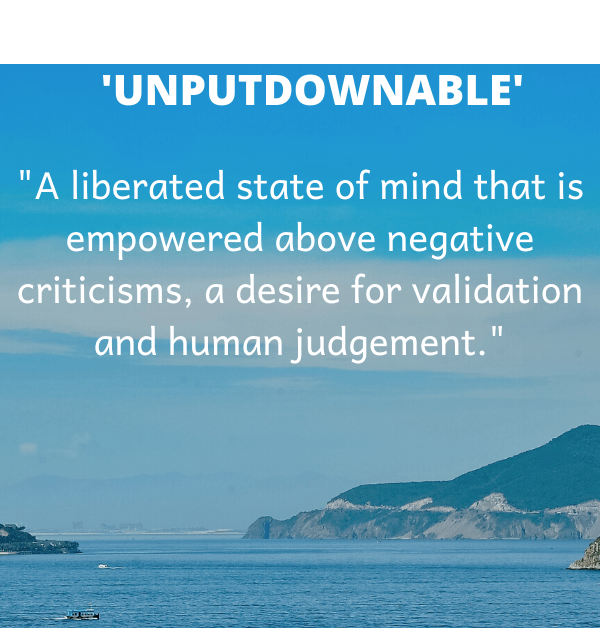
The word “Unputdownable” can be used as an adjective for books and spirits. It can also refer to athletes with a never-quit attitude. For example, the undying, unstoppable spirit of the drowning old man in the flood compels him to fight against all odds to survive.
One can argue that the word ‘unputdownable’ aptly describes gripping movies and web series because binge-watching and movie-watching are often done in a single sitting. But sadly, that’s not the case at all.
For many, puzzle-solving can be categorized as Unputdownable. Unputdownable typically refers to books, not other media. In literature, it is not intended to read a book in a single sitting, or even in two, whereas movies are meant for a single viewing.
According to neuroscience, the cerebral cortex primarily governs higher brain functions, including sensation, voluntary movement, thought, reasoning, and memory. When we concentrate intensely on completing an Unputdownable book, a spark in the cerebral hemisphere allows us to focus all our attention on one task and function more effectively.
We lose ourselves in books; we find ourselves there, too. Upon reading any Unputdownable book, the bibliomaniac gets close to salvation.
Literature can become barren and boring without at least one Unputdownable book every decade. Therefore, every budding writer should focus on touching the reader’s innermost feelings so the reader can visualize it as if it were happening to them.
As Scottish activist and writer Sara Sheridan very aptly said, “I am a storyteller, not a historian, and it’s my ambition to create something compelling—something Unputdownable and riveting—that chimes with real history but is, in fact, fiction.”
 The Witty Stride
Leave a comment