-Satyakam Ray
Nowadays, the average Indian’s psyche is precarious as it vacillates between the illumination of scientific temper and the darkness of religious-political bigotry. The disorientation among the general masses is quite disturbing, as they can’t decide whether the way forward is right or wrong. At this critical juncture in national consciousness, a detailed elaboration of the scientific temper and its importance in modern India is imperative.
The pertinent question comes to mind: What exactly is a scientific temper?
A scientific temper is a way of life that incorporates the scientific method in every aspect of life. Discussion, argument, and analysis are indispensable components of a scientific temperament. Scrutinizing the subject matter through hypothesis, observation, questioning, testing, and analysis is the natural discourse of action in pursuit of a scientific temper before arriving at any definitive conclusion. Therefore, elements of fairness, equality, and democracy are built on the principles of scientific temper.
Science and a scientific temper are distinct yet closely related concepts. A scientific temper is a way of thinking critically and rationally, characterized by the ability to question what is told to us and not be satisfied with an answer just because it is uttered by or attributed to an authority. The material prosperity and socio-economic independence we enjoy today are the byproducts of the relentless pursuit of a scientific temper by some visionary leaders and scientists of the past. A scientific temper is highly effective not only as a scientific tool but also as a social and political tool.
History:
The term scientific temper is entirely endemic. Late Prime Minister Jawaharlal Nehru coined the phrase in 1946.
In his book, The Discovery of India, Pandit Nehru wrote,” The scientific approach, the adventurous and yet critical temper of science, the search for truth and new knowledge, the refusal to accept anything without testing and trial, the capacity to change previous conclusions in the face of new evidence, the reliance on observed fact and not on pre-conceived theory, the rigid discipline of the mind—all this is necessary, not merely for the application of science but for life itself and the solution of its many problems.”
Constitutional Duty:
The Constitution of India encourages citizens to have a scientific temper. According to the Fundamental Duties under Article 51 A(h):
[It shall be the duty of every citizen of India] to develop the scientific temper, humanism, and the Spirit of inquiry and reform.
It’s tough to measure these traits by quantitative parameters. But in general, a person with a scientific temper should be a curious, active seeker of truth and dare to question authority. Skepticism and critical thinking form the core of the scientific Spirit. The notion of the Spirit of Inquiry manifests curiosity and can be observed in some people as an experimental attitude. Our constitution directs us to take the side of humanism, i.e., sympathy and empathy toward others, irrespective of caste, creed, or ethnicity, if doing so does not create a direct conflict of interest with nationalism. The Spirit of reform paved the way for attempts to change the world as a utopian dream.
Religion & scientific temper:
Scientific temper and Religion are antitheses of each other. Organized religions don’t permit questioning and scrutiny. It tends to close the mind and gives rise to intolerance, superstition, and irrationality. In contrast, a scientific temper is a free man’s, as Pandit Nehru pointed out.
Karl Marx said, “Religion is the sigh of the oppressed creature, the heart of a heartless world, and the soul of soulless conditions. It is the opium of the people.”
Pandit Nehru envisioned that the spread of a scientific temper would naturally diminish religion’s hold on people. It would lead to original thinking and various new possibilities. He stated that science alone could solve the problems of poverty, hunger, and draconian old customs.
However, science and spirituality can coexist. Swami Vivekananda’s outstanding contribution was to bring a scientific temper to religion. His approach was to believe nothing unless one had ascertained the truth or awaited a better explanation. For example, he did not accept miracles but did not deny their existence.
Significance in Modern India:
When British rulers left India in 1947, the country was plagued by poverty, famine, illiteracy, and superstitious customs. To add insult to injury, social unrest was at its peak, and communal harmony had reached an all-time low. We are now considered one of the global superpowers and enjoy the fruits of freedom as if it were our birthright. However, this economic and social freedom comes at a price. Almost seven decades of promoting a scientific temper have yielded some remarkable achievements.
- IITs and IIMs have established a unique reputation worldwide for delivering high-quality education and producing excellent graduates each year. Primary and university-level education have improved significantly, but further improvement remains necessary.
- As a result of this scientific temper, billions of people have enjoyed excellent economic conditions. Seeking validation in financial deals leads to shrewd business tactics.
- Social customs have become more liberal. Inter-cast marriage is considered very normal in middle-class families. However, inter-religious marriage is still a matter of factual dispute.
- Technology has become integral to modern life—a direct byproduct of the scientific temper. It has resulted in a comfortable, easy life.
- Visionary leaders and scientists have collaborated to establish research institutes that can have a profound impact on the global community. One such institute is ISRO. Considering its limited budget, ISRO’s achievements and laurels are impressive. DRDO has also promptly supplied India with its tactical defense equipment.
- Tata Group has generously funded and promoted Indian industrial growth by establishing various manufacturing plants, research institutes, and social welfare institutions. Even Infosys Chairman Narayana Murthy and Sudha Murthy have promoted a scientific temper by annually organizing the Infosys awards to acknowledge eminent scientists worldwide.
Social Deterrence:
Various social factors contribute to the erosion of the scientific temper.
- The Killing of Curiosity: Curiosity is the primary reason science has advanced so rapidly. Generally, children are naturally curious. Our flawed education system forces them to focus on rote learning. The examination process places supreme importance on textbooks, as if they were holy books. Teachers, the grading system, and parents discourage critical reasoning, questioning, and analysis from the outset. The rat race for better marks deters the budding pursuit of a scientific temper.
- Religious Authority—Religious authority over god-fearing citizens is immense. People consider it a moral crime to discuss religious textbooks logically from an early age. The scientific temper is the tendency not to accept anything new until it has been proven or tested.
- OCD– Psychological traits like OCD deter people from possessing a scientific temper daily. Consistent performance of specific tasks can make them habitual. It sometimes forces them to make decisions that they know are against their best interests.
- Social labyrinth: Indian culture discourages questioning authority, including that of the elderly. Even if the so-called revered person makes a mistake, we are taught to ignore it and move on in school.
- Muzzling of Free Speech – The freedom to express oneself without fear of external interference requires a conducive environment. The Indian mob doesn’t forgive a person if his views directly contradict a particular draconian ideology.
Promotion of Scientific Temper:
The Council of Scientific and Industrial Research (CSIR) initiated the Vigyan Mandir project under the leadership of Pandit Nehru. The CSIR publishes popular scientific periodicals, such as Vigyan Pragati. Centers were equipped with scientific tools, books, and films to promote a scientific temper among the rural population. In 1982, the National Council for Science and Technology Communication (NCSTC) was established under the Department of Science and Technology. NCSTC is mandated to communicate Science and Technology to the masses, stimulate a scientific and technological temper, and coordinate and orchestrate such efforts nationwide.
NCSTC organizes annual programs, including National Science Day and National Mathematics Day, the National Children’s Science Congress, the National Teachers’ Science Congress, and Science Express. It dedicated National Science Day on February 28, 2014, to the theme “Fostering Scientific Temper” to spread Nehru’s vision.
Current scenario:
However, the present context doesn’t give confidence to retain a scientific temper in society, considering how narrow-minded religious politics and the unchecked spread of hatred have muzzled the free-thinking rationalists. Several leading rationalists have been killed by extremists, and many others are on the hit list.
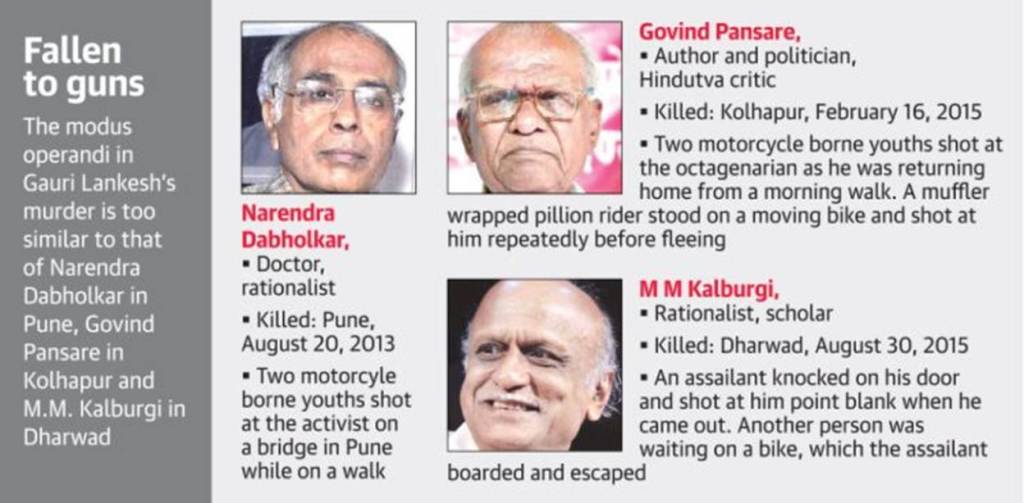
One such slain rationalist was Narendra Dabholkar. He founded the Maharashtra Blind Faith Eradication Committee and worked tirelessly to spread scientific temper and rationalism. Dr. Dabholkar was also the architect of the Anti-Superstition and Black Magic Ordinance. He was assassinated on August 20, 2013, by assailants yet to be caught for their efforts.
The All India Peoples Science Network, a network of over 40 Peoples Science Movements, has declared August 20 National Scientific Temper Day. Dabholkar’s message of rational thinking was subtle: “As much belief as there is evidence for.”
The attached critical-thinking attacks have persisted for several years. The events to date are listed below.
- The leader of the ruling party said that Lord Ganesha is proof that we had plastic surgery in ancient India. The scientific community mocked the statement, and it should have done so rightfully. The same leader, who denies global warming, casts doubt on the credibility and veracity of his statements among those with sound judgment.
- One of the ministers stated that the Vedas (ancient texts) had revealed the Laws of motion long before Newton. The same minister publicly denounced Darwin’s theory of evolution, saying no one had ever seen a monkey transform into a human being.
- One minister in Rajasthan advanced another “scientific” theory, claiming that the cow was the only animal that inhaled and exhaled oxygen.
- A newly elected chief minister in an Indian state declared that TV and the Internet were invented thousands of years ago in ancient India.
- The Indian Science Congress was compelled to hold a session on “Ancient Science through Sanskrit.” During that session, various ridiculous claims were made. One paper, among six presented, claimed that ancient Indians had invented ‘two-hundred-foot planes that could fly forwards, backward, and sideways, hover in mid-air, with up to 30 engines during the time of the Vedas and 20 systems for wartime purposes.
- One incumbent central minister claimed that the Pythagoras theorem was invented in India.
- Noted rationalists like MM Kalburgi, Govind Pansare, and Gauri Lankesh have been killed by hardliner fundamentalists.
- The Government established a 19-member national steering committee to scientifically validate research on five bovine derivatives (cow urine, cow dung, cow milk, curd, and ghee made from cow milk), collectively known as panchgavya. It is as if scientists have nothing but essential tasks.
- An incumbent fundamentalist minister stated that finding the missing mythological river, Saraswati, was one of the current Government’s priorities.
- The Department of Ayurveda, Yoga, Naturopathy, Unani, Siddha, and Homoeopathy in Uttarakhand formed a committee to investigate why the Hindu god Hanuman is said to have moved a mountain. The apparent reason was to acquire the mythical Sanjeevani Booti, a panacea.
- IIT Kharagpur was compelled to introduce a course on Vastu Shastra, a traditional Hindu architectural concept, for first- and second-year undergraduate architecture students.
- Swami Ramdev’s breakthrough corona medicine, Coronil, was recently shamelessly promoted. The alleged treatment had not undergone any specified regulatory tests, and it made tall claims of curing coronavirus.
- Social media posts claiming that the coronavirus can be eliminated by drinking cow urine have been circulating for some time. A central minister’s promotion of Bhabhiji papad as a remedy for coronavirus immunity was hilarious.
- Similarly, the “Go corona go” chant to drive the virus out of Indian soil was also unsuccessful!
- The TRP-hungry media adopted the black-magic angle and even spoke with Sushant’s Spirit. Not least, the appearance and arrest of godmen and god-women in the spiritual market have now become the norm. The vicious cycle is a pervasive phenomenon in the public domain. In that respect, we are atma-nirbhara (self-reliant)!
Scientists’ response to attempts to tamper with the scientific temper is strong. As an All India Peoples Science Network statement says, “The aggressive anti-science and anti-rational atmosphere whipped up by obscurantist forces with official support has generated a climate of intimidation and even violence in an attempt to suppress a scientific outlook and critical thinking in our educational and intellectual institutions.”
Dangers lurking ahead:
Rational thinking is essential for the country’s social and economic development. Illogical national policies can set back development by several decades. The thoughtless decision-making of the incumbent leaders affects the well-being of the entire population. The efforts to form a theocratic fundamentalist state won’t be appreciated by ordinary citizens who voted for a Utopian progressive state, as claimed by the manifesto during the election. History suggests that any country based solely on religion has failed miserably. Take Pakistan, our neighboring country, and compare its progress with ours. Signs of Indian failure have already come to light, including a 23.9% quarter-on-quarter decline in GDP and India becoming the second-most affected country by the coronavirus pandemic. The government’s measures have already backfired in the economy and in coronavirus control. Pursuing a scientific temper before making critical decisions would have been instrumental in reversing the current dire situation.
Road Ahead:
Nobel Laureate Venki Ramakrishnan emphasized fostering a spirit of inquiry and science through large and small collaborations. “Science flourishes when there is absolute freedom of thought and opinion and minimum ideological interference,” he said. His advice for India is to separate the Government from the scientific establishment and distance science funding from politics.
The way to prosperity lies in the hands of the youth, scientists, media, and the general public.
- Youth role: Indian youth should begin to analyze and question policies rather than blindly accept everything they hear. Every aspect of life should be thoroughly scrutinized, and a scientific temper should be adequately retained.
- Scientists’ role: Scientific principles should be made accessible to school and college students through seminars, webinars, and workshops. The talks on scientific temper by practicing scientists should be made public. Unmeritorious guest lectures must not be allowed in the National Science Congress. Otherwise, eminent luminaries will boycott Congress forever and ridicule it as a circus in the international scientific community. The ridicule process has already started.
- Media role: The media should be unbiased and refrain from promoting misinformation. They should also respect journalism as a discipline. Already, the Indian media is in a mess. Every rational Indian has stopped watching TV for quite some time now, and the media has become a laughing stock, just like the Science Congress.
- Public role—The general public should apply the principles of a scientific temper in their daily lives. They shouldn’t be lured by obnoxious TV advertisements or diverted by fake WhatsApp messages. Most importantly, the public must stop watching Astrology content on TV, as it is pseudoscience and only fosters lies. If anybody wants success, they must work hard. Period!
- Students’ role—To secure good marks, Students should focus more on practicals or hands-on learning than on remembering some scientific facts. How the facts were derived is more important than the facts themselves. The science of temper is a toolkit for exploring various phenomena. Students should be vigilant in that regard.

India is currently at a crossroads. The urge to become a theocratic country can backfire at any time. In this context, Swami Vivekananda’s assessment of Religion is pivotal. Swamiji emphasized the importance of spiritual realization. Religion’s critical test of truth, however sacred, was mere prattle for the non-realized. The blind believer can only bask in the glory of his stupid belief without growing an iota. Religion is realization; everything else is filth and froth. Following the blueprint of a new Indian vision with a scientific temper is the only way forward. Don’t tamper with it!
 The Witty Stride
Leave a comment