-Satyakam Ray
Instance-01
Abdul is a small-time vegetable vendor selling his freshly procured veggies on the outskirts of a small town in India. His meager income is insufficient to meet his family’s needs, let alone to save for the future. Abdul was at his wits’ end about how to survive with his limited savings. One day, a nationwide lockdown was suddenly declared to curb the spread of the epidemic.
Finally, the government announced some relaxation of the lockdown. Abdul finally went to his usual place to use the restroom. On the first day, he saw something unusual that kept him awake all night. His competitor, a Hindu vegetable vendor, had placed a saffron flag on his cart and proudly told customers that his veggies were safe. The ugly pointing and indistinct gossip caught the attention of Abdul, who was being labeled as a jihadi by the nearby shop owners. Not a single customer bought veggies from him, and instead, they alleged he gave them poison in the form of vegetables. Abdul’s mind was boggled, and all the trials for persuading others to buy any produce were futile.
Abdul could not fathom what had prompted the friendly neighborhood to become a disgusting drain of communal garbage over the course of a month or so. This resulted from a long-standing perception attack by the media on the Muslim community of being vicious and super-spreaders of the coronavirus.
Instance-02
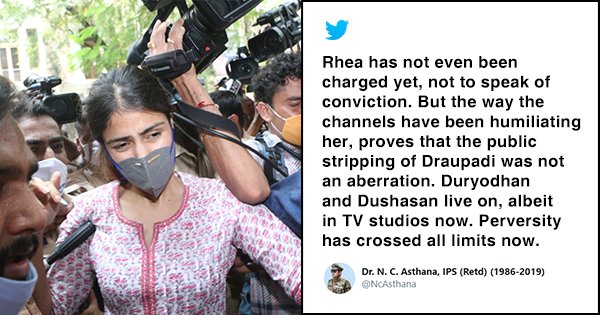
On June 14, 2020, a promising and talented actor in the Bollywood film industry passed away. The national media got content for bytes and TRP. An avalanche of special reports, exclusives, and “nation wants to know” popped up on television screens for the consumption of the bemused Indian junta. At least 7-8 angles/reasons for the alleged murder or suicide case have been presented in prime time on TV.
But to date, the murder investigation has borne no fruit, and the justice for SSR has become a sort of chimera. Instead, the spotlight has shifted to the late actor’s girlfriend’s drug addiction and how she procured drugs. The way the media covered Rhea’s case has become a circus and pathetic. Specifically, the incident in which the camera crew and journalists shoved their microphones into Rhea’s face to get a statement was, to put it mildly, worrisome and egregious.
Instance-03
Doing a parallel investigation into the nexus of the Bollywood drug, one obnoxious prime-time anchor begged for drugs on screen. Although it was not a literal begging, it was an assiduous attempt to garner ratings points (TRP). It’s no wonder the channel is now number one. Moreover, it provided political mileage to a retiring Bihari police officer and a less-than-benevolent actress. The whole circus runs on the assumption that Indian people are gullible.
Instance-04
The demolition of a particular right-wing actress’s illegal balconies in Bombay has created a stir among the media, which calls it the death of Democracy. The innumerable deaths related to the migrant crisis, unemployment, farmer distress, and economic crisis of middle-class people bear no importance for such TRP-hungry media. On national television, they asked celebrities questions about Taimur’s poo, while migrant workers were enduring many hardships on their way back home.
Instance-05
Someone could access the private end-to-end encrypted chat between individuals and spit venom on national television by name-calling and character assassination without proof. This type of factless reporting has set the ground rules for “breaking news” in the Indian media today.
Instance-06
One biased journalist of a specific Hindutva channel questioned the entire selection process of UPSC and alleged ” Jihad” by Muslim candidates to enter into bureaucracy. The unprecedented telecast was bigoted and laughable. As expected, numerous protests and criticisms occurred. The matter is sub judice now.
In addition to these noteworthy instances of media insensitivity and unethical journalism, numerous other incidents of media hypocrisy are observed daily on television screens. In the race to become the fastest channel to telecast news to the nation, TV channels have sunk to an abysmally low level in terms of content, language choices, and inhumanity.
4th Pillar of Indian Democracy: The Legislature, Executive, and Judiciary are the three eminent pillars of Democracy. The media is the watchdog of the three pillars of Democracy. Media is broad, encompassing three types: electronic, print, and digital. English author Edward Bulwer-Lytton said that the Pen is mightier than the sword. A credible journalist reports the incident as it occurred, without bias or malice. A journalist’s heart and soul should be modest and morally correct. The fourth pillar, Media, plays a vibrant and vital role; however, when it fails to align with the other three, Democracy becomes cancerous.
Constitutional Right: Freedom of the press is not explicitly mentioned in Article 19(1) (a) of the Constitution. In the Constituent Assembly Debates, Dr. Ambedkar clarified that no special mention of the press’s release was necessary, as the media, individuals, and citizens were treated equally in their right to expression.
Article 19(1) Freedom of Speech and Expression: Freedom of Speech and Expression means the right to express one’s convictions and opinions freely by word of mouth, writing, printing, pictures, or any other mode. Thus, it encompasses the representation of one’s ideas through any communicative medium or visible form, such as gestures, signs, and similar expressions.
Game of TRP: The moral decay of the Indian media stems from the vicious competition for TRP. Almost all anchors use harsh, offensive tones and a high-pitched voice to increase viewership. Even the background can have more subtle effects and may include objectionable or sensitive images or videos. The headlines of TV news give linguistics experts severe headaches and sour rational viewers. Institutional news reporting has been replaced by #journalism. Even the so-called popular anchors conduct polls to validate their propaganda. Some of the TV show names are also problematic, such as Halla Bol, DNA, and Puchhata Hai Bharat.
TV news channels operate on an advertising revenue model. The track is more successful if it bags more ads. Maintaining political and corporate relationships is paramount to securing the ads. Many politicians own channels or hold significant stakes in media companies. Right, the content is primarily biased and favors a particular political party. For instance, one channel aired a story showing how many times the head of the ruling party folded his hands during the Man Ki Baat program.
Media Distraction: India is currently the 2nd-most affected country globally by the coronavirus. The daily infection rate is the highest in all countries. The economy is in turmoil, and India’s quarterly GDP growth rate has reached -23.9% for the first time. The unemployment rate is the highest in at least 45-46 years. At least several crores of Indian salaried people have lost their jobs. Not to mention the woes of unorganized sector workers! The tragic scene of migrant workers returning to their native place during lockdown was heart-wrenching. The Constitution’s institutional framework is in jeopardy, and its independence is in question. The farmers’ agitation across India has reached a peak due to the controversial farm bills. Only two corporations are securing all the projects amid highly suspicious business deals. The Chinese made an incursion into our land.
Ultra-nationalism and fake pride have curbed the space for rational, unbiased, and accurate reporting about real people. The mainstream media should have highlighted these issues and held the ruling party accountable. Strangely, however, the most biased press always asks the opposition, which is very weak. It seems the media is playing second fiddle to Hindutva’s ideological propaganda.
It’s a shame that when the country faces a severe economic crisis, the media discusses Rhea/Kangana trivia and the drug nexus of Bollywood. As if there are no other issues ordinary people face, our credulous citizens are more interested in knowing what happened at a Bollywood page-3 party. During the Bhoomi puja of the Ram temple, news channel anchors adopted a more traditional approach, wearing Indian attire. During the 2019 budget presentation, the media showed our finance minister as the incarnation of Maa Lakshmi. Popularly, the media that favors the ruling party has been labeled as “Godi” media.

Media trials and debates: Any debate aims to gather diverse perspectives on a common topic and to discuss all aspects of the issue in detail. Therefore, many subject experts, professionals, political leaders from different parties, social service workers, authors, intellectuals, and individuals from the entertainment industry can freely discuss topics of national importance on TV.
Loud shouting, name-calling, quarreling, or thrashing have become common in newsroom debates. Sadly, the sanctity of such arguments has been compromised, and the discussion often deviates from its intended purpose. Panelists compete farcically to see who can produce the loudest decibels. The media’s witch hunt for any person is scary. Even if the matter is sub judice or the person is only alleged, it does not deter the media from persecuting or vilifying that person by conducting a separate, so-called parallel investigation.
The Sanskari level of a news channel reached its zenith when a retired army officer used profanity on live TV. It was taken lightly, and it seems that cursing on camera may also become the norm.
The situation has become so aggravated that parents of small children have to use a child lock to censor TV debates/channels. Because it is feared that too much aggression and hate speech affect young minds. Even adults should refrain from watching such nonsense on TV.
Curbing by Courts: The Bombay High Court has recently quashed a first information report and charge sheet filed against eight Myanmar nationals who attended a Tablighi Jamaat congregation in the Nizamuddin area of Delhi during the coronavirus-induced lockdown in March.
A bench of Justices VM Deshpande and Justice Amit B Borkar said prosecuting the eight Myanmar nationals would be an “abuse of the court process” due to a lack of evidence to support the charges against the foreigners. “It is also not disputed that they were kept in isolation from 24.03.2020 till 31.03.2020 under Dr. Khawaj, NMC Zonal Officer, Mominpura, Nagpur,” the court said. “There is no material on record to prove that applicants had indulged in any act which was likely to spread infection of Covid-19.”
The program’s content on Sudarshan TV had infuriated the Supreme Court, which, in a hearing last week, had called the show an attempt to vilify Muslims.
“You cannot target one community and brand them in a particular manner,” the top court said, temporarily stopping the show “Bindas Bol. Seven of its nine episodes remain to air.
International Criticism: Indian Media has become a laughing stock in the International arena. While the US media can grill its president over the coronavirus spike, the Indian press can ask silly, trivial questions like’ Aap thakte Kyun nahi’ (Why didn’t you get tired) or’ Aap Batwa rakhte hai kya’ (Do you have a purse) to our leader. The level of stupidity and sycophancy during such interviews is astounding. Leveling a captured pigeon as a Pakistani spy and the mere numbers on its legs turning into a secret code conjecture have not gone well with the international news anchors.
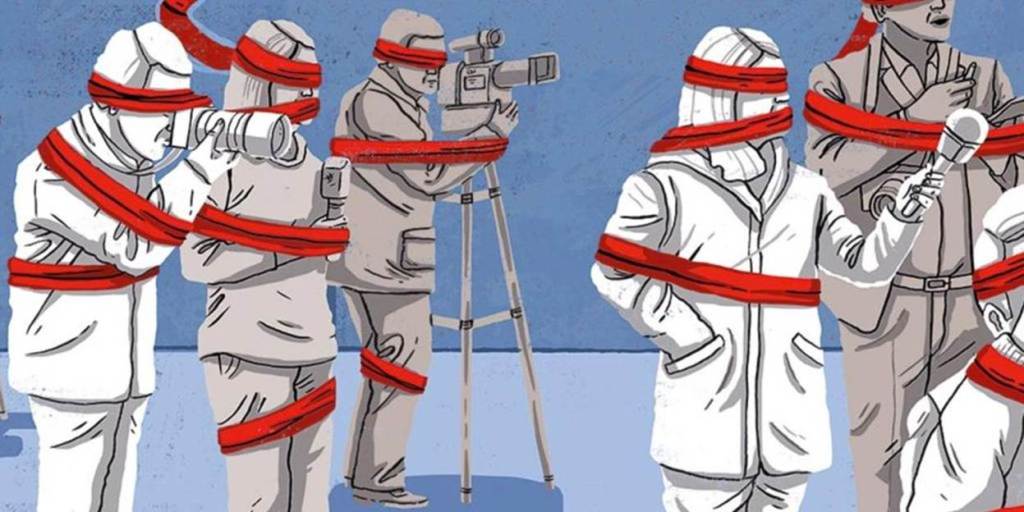
The Reporters Without Borders annual Press Freedom Index, released on April 21, ranked India 142nd out of 180 countries.
Paris-based Reporters Sans Frontières (RSF), or Reporters Without Borders, is a non-profit organization dedicated to documenting and combating attacks on journalists worldwide. Its report said, “With no murders of journalists in India in 2019, as against six in 2018, the security situation for the country’s media might have improved. However, there have been constant press freedom violations, including police violence against journalists, ambushes by political activists, and reprisals instigated by criminal groups or corrupt local officials.”
Media circus: The Indian media circus has become a parody of the story narrated in Peepli Live. The insensitivity and unethical approach of the media personnel crosses all limits when they shove microphones in the faces of grieving family members upon the death of a loved one and ask, “How are you feeling?
Public Backlash: The public can respond to media coverage when it invades others’ privacy and intrudes into their personal lives. The recent thrashing of a reporter by relatives of an alleged drug peddler gave sufficient content for meme creation. Similarly, the roasting of a lady reporter by the Crane driver of the Mumbai BMC was hilarious. When asked, “What’s your name?” the driver replied, “What would you do with my name?” in a manner that appeared threatening.
The reporters’ usual excuse, “I am just doing my job,” won’t suffice to appease an angry public if they continue to harass ordinary people with microphones and cameras.
In particular, prominent NDTV journalists have cautioned the public against watching prime-time TV. According to him, institutional journalism is already dead in India. Very few people have maintained their integrity and ethics upright in Indian Journalism. There is still some hope left in the mainstream media. Digital media is still free for some supplementary content compared with print and electronic media, in terms of content and regulation. Despite their limited reach, many sensible and concerned YouTubers are trying to educate people about the current situation. Stand-up comedians and satirists provide accurate news, whereas mainstream channels are disseminatingforwarded WhatsApp fake messages.
Someone has rightly pointed out that “Now journalists are working like comedians, and the comedians are doing the job of journalists!”
Note: Abdul is just a fictional name. But the issue is real.
 The Witty Stride
Leave a comment