You see a family having a minor disagreement over the cost of food. This often happens when they are looking at the Menu of a high-end restaurant. It’s easy to deduce that the family is middle-class. It’s the most probable conclusion. Many wealthy families show similar behavior. Still, seeing and comparing the restaurant menu is the foremost inner trait of every middle-class family. It’s in the genes of every progeny of the middle class. It doesn’t matter how successful one becomes or how much wealth one accumulates. For those from a middle-class upbringing, checking the menu on the right-hand side is the norm.
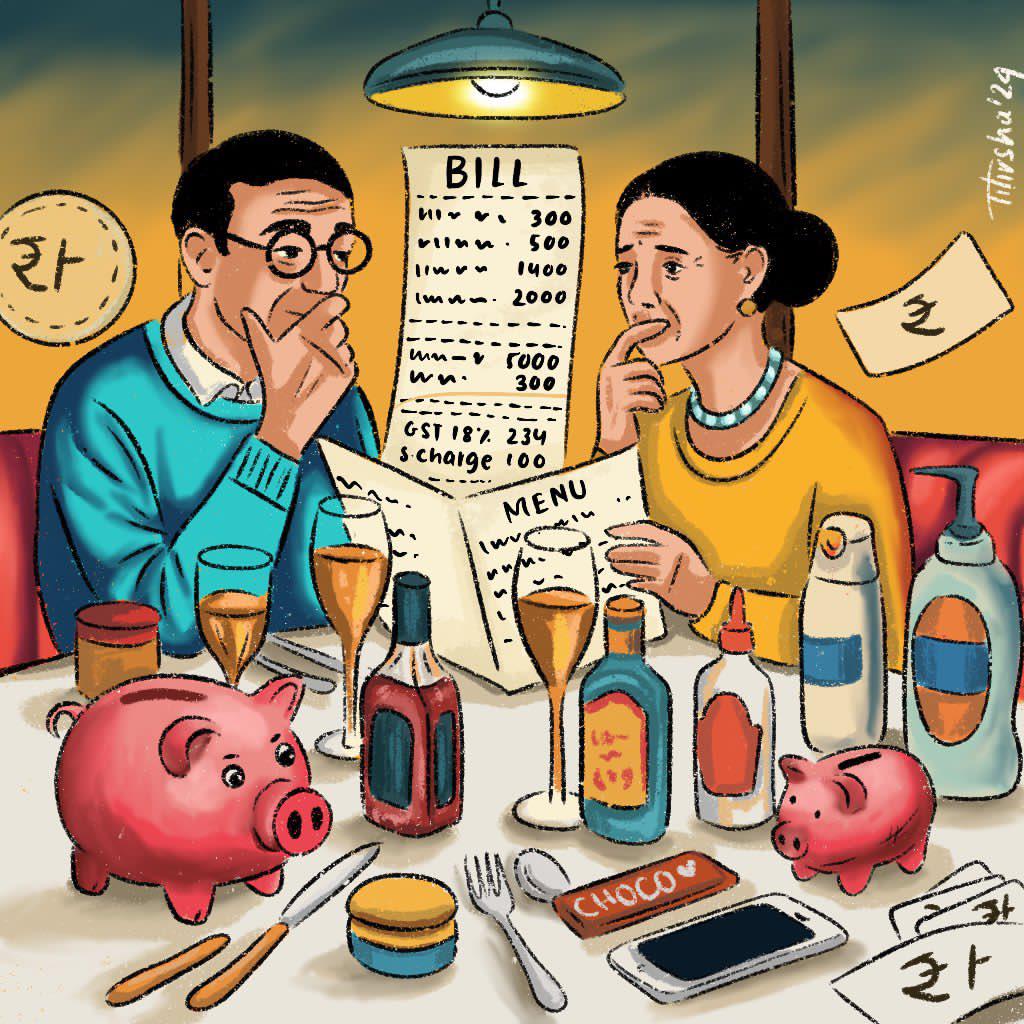
Frugality and the middle class are often used interchangeably. There are very few exceptions for those who love to spend freely in the middle class. Wealthy people usually spend more freely and have fewer social inhibitions. The lower-income section similarly has fewer social inhibitions or self-imposed boundaries but pays less. Still, middle-class people have moderate social boundaries and a moderate-to-high spending capacity.
There are several reasons why the middle class is so frugal. The Indian dream is to own a house and a car. This aspiration has led to a reliance on banks for personal and home loans. Education is important. It offers the prospects of a promising future. Hence, education loans are again becoming relevant for many households. Loan EMIs and rising inflation contribute to financial problems for middle-class families. Health issues of elderly parents and babies also play a part. Additionally, the urge to showcase fake status through frequent purchases and the rat race are significant factors. Frugality and wise wealth management are essential survival strategies in these challenging economic times.
Not only is the Menu on the right-hand side, but there are also many ways to practice frugal behavior. Middle-class people often haggle with local fruit and vegetable vendors. They seek extra curry leaves for free. They wait for the Big Billion sales on Flipkart or Amazon. These individuals compare and calculate the Return on Investment (ROI) on every buy. They check the warranty card on every purchase, whether online or offline. Asking the seller “kitna degi” is also common, not only in the automobile industry. There are many other infamous or peculiar activities of middle-class people.
Different age groups within the same middle-class household show distinct behaviors. The Boomers, or the older generation, are usually more frugal. They understand the importance of saving after experiencing hardships caused by financial constraints. Millennials behave moderately frugally, but sometimes spend freely. The new generation, or Gen Z, is more likely to spend freely on worldly things.
The Piggy Bank concept is popular among 90s kids. It showcases how a child saves money in a piggy bank for future use. This is the earliest example of frugality in an Indian middle-class household. Middle-class moms have a strong urge to save for a rainy day. This is especially true for family and health issues. The need to save is more pronounced among them than others. During emergencies, the required funds are usually sourced from homemakers’ hidden resources.
The Peculiar cases of an Instagram reel summarize the Indian mentality and middle-class drama. In the reel, a couple is planning to buy iPhones. They are also trying to squeeze out the last of the paste from an almost-empty toothpaste tube. The Indian middle class tends to overuse toothpaste. Yet, they are determined to buy an iPhone for fake social status among friends and relatives. The Indian middle class prioritizes luxury. This happens even as they struggle to make ends meet in challenging economic conditions. It’s indeed peculiar!
 The Witty Stride
Leave a comment