–Satyakam Ray
Dark alleyways, a dilapidated bungalow, and there lived a chudail (ghost). She wore a white saree and walked out at night, holding a candle. She had no eyes. Instead, there were reflections of a menacing monster lurking near the old building. Some unlucky late-night Bypassers saw this.
It is not a fictional tale to spook readers. It’s the most common figment of the imagination we cultivated as ’90s kids. Let’s shed some light on this trivial aspect of their experience.
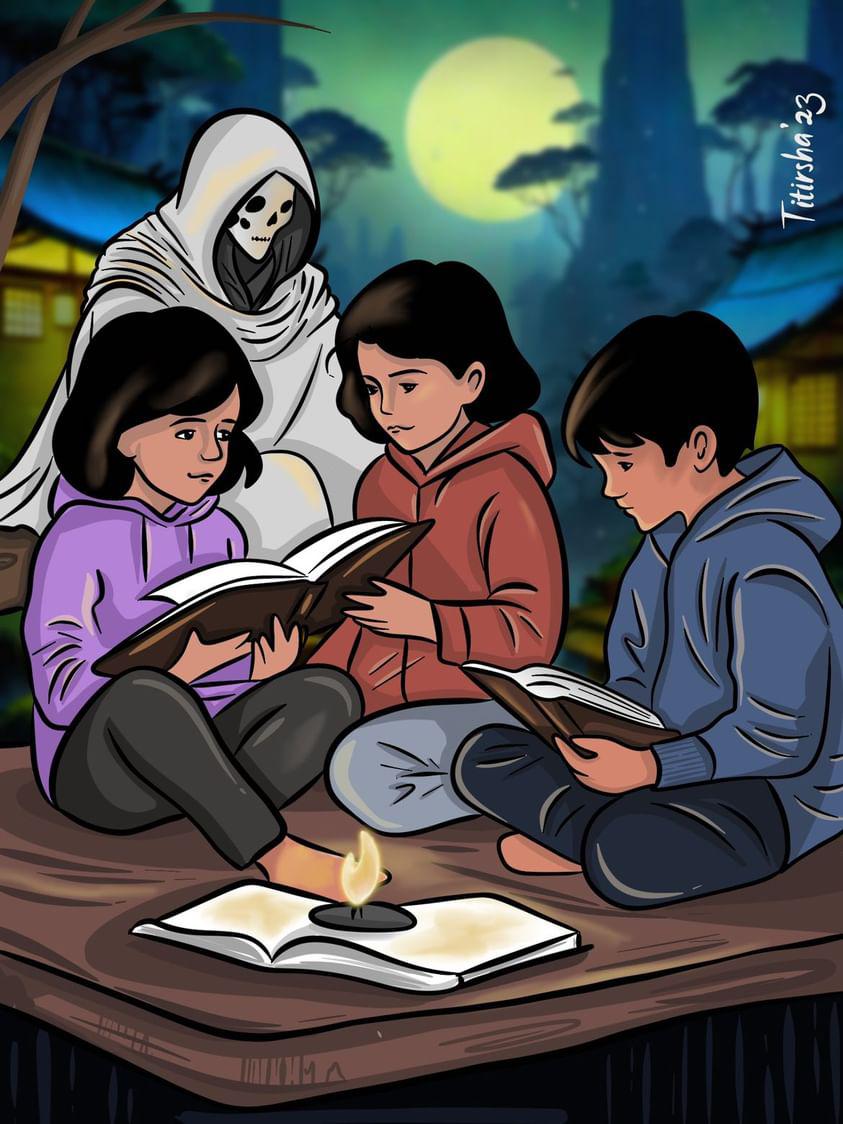
Granny never disappoints the children, narrating one story after another from her memory to entertain them. The ghost story’s narration centers partly on a group of cousins. It also focuses on an elderly grandmother during their summer vacation from school. As time passes, the eager group of urchins surrounds the granny. They are anxious to hear exciting, unfiltered stories of the past. They do this just for fun. Few are true stories. Many are fabricated beyond imagination. These stories instill fear in children as an excuse to make them obey orders. Regardless of the stories’ authenticity, Kids grasped them without question and remembered them for the rest of their lives. This is why many adults face sleep paralysis disorder or paranoia over the dark and ghosts.
With the proliferation of power backups, line cuts stay elusive to youngsters. In the 1990s, power cuts happened often. Teenage siblings and cousins invented many exciting games to pass the time. Discussing ghosts and narrating haunted places were among the teenagers’ favorite pastimes then. While it was raining outside, a truth-or-dare game in the dark was the main attraction for those dark-hour enthusiasts.
Conjuring and Annabelle are among the most terrifying ghost movies of recent years. But one episode of Aahat or Shh Koi Hai was enough to spook the ’90s kids. To this day, no ghost serial in Indian television history has affected ’90s kids as much as this one. Aahat had a profound impact on them.
Bhangarh, a Rajasthan fort, is renowned worldwide for its reputed haunting. Many go there to explore the possibility of ghosts and experience it firsthand. Paranormal enthusiasts of today enjoyed their granny’s ghost stories. They listened during their school days as 90s kids. The curiosity to unearth the unknown is an addiction. Once it gets into the system, it remains the same throughout. As 90s kids, we must have explored our version of a Bhangarh-type mystery in our locality. Gullible teenagers spread rumors and accept ghost stories. This behavior can lead to an increase in the number of adults who are afraid of ghosts and paranoid. Thus, they become so scared to step outside in the dark.
The author does not imply any deniability or acceptability about the existence of ghosts. It’s just subjective speculation and a topic of debate among believers and non-believers. But the thrill of being a ’90s kid listening to ghost stories is unparalleled. The kids’ spontaneous eagerness to grasp the dark realm is unmatched.
A fascinating short anecdote to conclude this ghost-related narrative is as follows. As a ’90s kid, the author listened to these ghost stories and got spooked. Once, during a school break, four of my friends were discussing ghosts and horror experiences in the school’s common room. There was nobody in the room except the four of us. Moreover, it was rumored to be haunted. All of a sudden, we heard a stomping sound in the corner. We panicked, and a friend started chanting Hanuman Chalisa loudly. Two friends gathered courage and approached the corner to see what it was. It was a tiny frog trapped in polythene, trying to get out, thus making a stomping sound. That proved the effects of ghost stories on our subconscious. Some stories may be true, while others may be false. As a ’90s kid, I shared ghost stories around the fire with cousins or friends on chilly winter nights. That is an emotion no smart gadget can replicate for Gen Z.
 The Witty Stride
Leave a comment