– Aparna Chatterjee
Ancient India had many dialects and languages. Several language families are known, of which seven are recognized. However, two families of languages dominated the subcontinent and continued to flourish: the Indo-Aryan and Dravidian Languages. We have discovered ancient texts and manuscripts from both branches of the Sangam. One particular work still leaves us wondering about the advances made when humans from many regions lived in caves and hunted for subsistence.
Sangam means association. Sangam also means union. This beautiful work unified the ancient poets; hence, it is also known as “the poetry of the nobles.” Written in the oldest living language of the subcontinent, Tamil, Sangam is also considered the oldest literary work in Tamil. How old, you may ask? It dates to 300 BCE, while the latest addition is said to have been composed in 300 CE. It is so old that the first compositions were held in South Madurai and Kapatapuram, both of which have since been submerged by the sea.
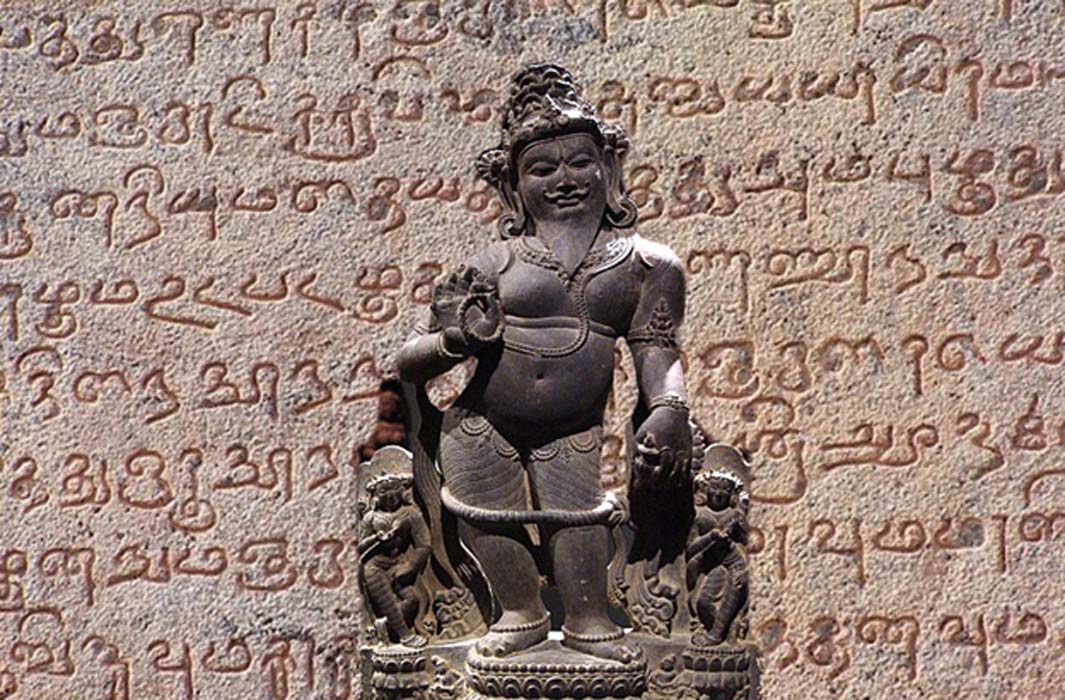
It discusses the lives of the past. Between 300 BCE and 300 CE, three Sangams were composed, adding complexity and dimension to the latest one and laying the foundation of the Tamil language as we know it today. The first Sangam was composed by the well-known and revered Rishi Agastya, who laid the foundation for Tamil grammar. The poems from this period primarily focused on Lord Shiva, his son Murugan, Kubera, and the Rishi Agastya.
Later, Rishi Agastya’s disciple, Tolkappiar, continued the work and composed the second epoch under his Guru’s guidance. This epoch spanned three millennia and concluded with a giant flood on the eastern seashore of Kapatapuram. The legends Tolkappiar and Akattiyam survived and guided the scholars for the third composition. The third composition uncovered most of the knowledge. Not only did learned scholars contribute, but people from different walks of life did as well. Religious poems from Hinduism, Buddhism, and Jainism praise their Gods and Goddesses, carpenters, merchants, and chieftains, and describe their work and trades.
The region was divided into five distinct areas based on their topography: Kurinji, a hilly region; Mullai, characterized by forests and pastures; Marudham, fertile land; Neydal, the coastal zone; and Palai, a desert region. Palai was not a desert like the Sahara, but it did face acute drought. Each part found sustainable ways of producing food. The Palai region was famous for its pickled food. The vegetables and meat would be dried over the year and stored with spices. As agricultural techniques developed, the remaining areas had numerous sources of meat and vegetables.
We gain a clear picture of international relations and trade among the ancient Greek, Roman, and Mesopotamian civilizations. The Greeks had trade relations with the Tamils since the third century B.C. Many Roman coins found in this region date to the reigns of Caesar, Tiberius, and Nero, suggesting that Roman–Tamil trade relations likely began in the 1st- 2nd centuries A.D. We see contributions from many poetesses, such as Avvaiyar, Kakkai, and Padiniyar. We have gifts from princes to rishis to peasants, providing a comprehensive view of life.
Interestingly, the first two ancient epochs mention a submerged land known as Kumari Kandam. This mythical continent stretched between India, Australia, and Africa. It is said to have been lost at sea. A few believe that the Vedas we know today originated here and were called Vedhams. It is widely held that only 20% of the ancient knowledge recorded in the five Vedas was preserved, and that four of the Vedas were formulated. Historians tend to dismiss these speculations for lack of evidence. It is also linked to the lost continent of Lemuria. Biologists from the 1800s suggested that this landmass connecting the three continents facilitated the migration of prosimians.
Mythological or not, Sangam literature depicts the feats of ancient humans. It is evidence of Indigenous development in literature, the economy, social structure, and people. The beauty of this anthology lies in the contributions of both the rich and the poor, from scholars to commoners. 473 poets captured their beliefs, day-to-day lives, aspirations, and pride, thereby glorifying the age-old saying that a nation’s strength lies not only in its ruler but also in its people. While the Tamil language’s development, the era’s cuisine, and the importance and use of gold and other gems may be similar to those of the current era, it is striking to see people connected by culture yet disconnected by time.
Even though the first and second Sangams remain mysteries, seeing them through the lens of the third epoch gives us something to hold on to while the rest is lost.
 The Witty Stride
Leave a comment