– Aparna Chatterjee
Human curiosity knows no limit. While this fascination can lead to the discovery of the theory of relativity and inspire others to have lucid dreams, human-animal hybrid characters leave no stone unturned in arousing the imagination of curiosity-seekers worldwide. We have angels, human-like figures with wings; Sekhmet, a woman with a cat’s head; Centaurs, who have the upper body of a human and the lower body of a horse; Bai Ze, who has the head of a human and the body of a cow, etc. We have Lord Matsya with a human-fish hybrid body, Lord Narsimha with a lion’s head, claws, and a human body, and Garuda with an eagle’s body and a human hybrid body. Indian, Greek, Egyptian, East Asian, Christian, and Arabic myths flourished around such characters. As the Greeks refer to those mythical creatures, werewolves, or Lycanthropes, are just one of many personifications.
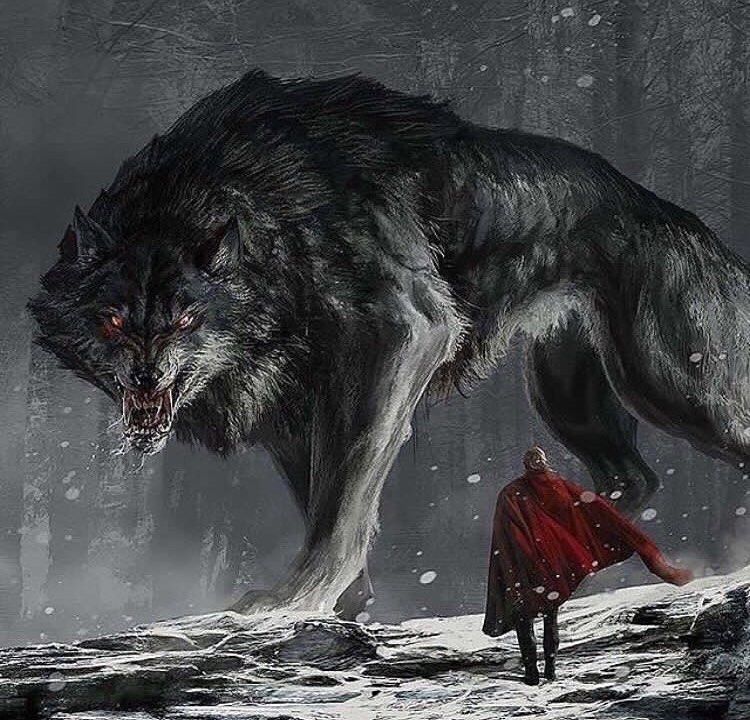
The origin of werewolves dates back to around 1150 AD. Contrary to the popular belief that werewolves are a sort of human-wolf hybrid, they’re creatures with shape-shifting abilities. That means this creature can appear as a normal-looking human being and then transform into a wolf or a mixture of both. Tales of Lycanthropic soldiers are frequent in ancient Greece. One such account is about Lycaon, the king of Arcadia. Zeus, the god of the sky, had invited Lycaon for dinner. Lycaon wanted to know his real name, thinking this was a trick. Lycaon tried to feed Zeus human flesh and hired assassins to kill him in his sleep to test his immortality. Angered by these actions, Zeus kills Lycaon’s sons with lightning bolts and curses Lycaon to become the first-ever Lycanthrope. Later, Lycaon formed the famous Lycanthrope army, which worked for Orion, a giant.
The story goes that he who tastes of the one bit of human entrails minced up with those of other victims is inevitably transformed into a wolf.”
– Plato.
The folklore of werewolves evolved in parallel with that of witches and vampires, but without the grandeur of Greek mythological characters. However, the werewolf’s second name was Fear, like the vampires. A person could become a werewolf by getting bitten or scratched by one. If not eaten by the werewolves, of course! Scandinavians had it a bit, kveldlf or evening-wolf, after Kveldulf Bjalfason from the Icelandic saga, a mighty Viking military commander and a well-known landowner from the 9th century. Europe was overrun with wolves, and wolf attacks were common. Wolves are humongous and intelligent; they attack in well-coordinated packs. That was the perfect scenario for much folklore to spread widely.
In the Nordic region, Fear the Wolf originated from the Gods. Loki, a juton, was a very capable shape-shifter with several non-human children, one of whom was Fenrir. The Gods feared Fenrir as he was prophesied to kill Odin. Therefore, he was kept under the gods’ control right from birth. Being scared of the might of Fenrir, they kept him chained up with his mouth held open, pierced with a sword, where his drooling formed a river. He stayed there as long as the great Ragnarök happened. In Ragnarök, he fought with Odin and was eventually killed by Thor, Odin’s son. His might, power, and size made people tremble with fear. The earth shook at his steps. Another version of the story is one in which the Gods don’t care about Odin and let Fenrir live, given the wrath that could come from this mighty wolf’s blood.
So far, we have seen this creature only in our mythology. But is it possible for those to exist in recent times? In 2017, a weird human-like skull was discovered by a European farmer. The locals dreaded that it was a bad omen and that the mighty beasts would return. Further scientific analysis revealed that the skull belonged to a wolf with Paget’s disease, a condition characterized by excessive bone growth. Then, there is the case of clinical lycanthropy, a psychiatric condition in which the person deludes themselves that they can transform into an animal. It is being argued that people claiming to see werewolves saw a person suffering from congenital porphyria, as the symptoms, like photosensitivity, reddish teeth, and erratic psychological behavior, match the usual description of werewolves. Additionally, the victims of hypertrichosis could also have been accused of being werewolves, as this condition inhibits the immense growth of hair all over the body. It has also been said that the idea of one turning into a werewolf on being scratched or bitten has been manifested by the victim suffering from rabies.
The character originated from a time when anything and everything abnormal was perceived as satanic. Thousands of women were burned alive at the stake under the pretext of being witches, and more people were slaughtered in vampire hunts. One can only imagine what would happen if a person suffering from an unknown, dreadful disease were discovered in current times. But would humans be so naïve as to create such grand tales based on mere speculations? Or was this something only a God could do? Is it possible that somewhere around the world, in a quiet town still intact with its forest, these shape-shifters are well-versed with the standard/acceptable way of human living and have tamed down to eat meat from the butcher shop? I guess we’ll never know.
 The Witty Stride
Leave a comment