– Aparna Chatterjee
If you were born and raised in India, you must have had a childhood filled with mythical stories. We were raised on stories of Lord Krishna’s mischief and bravery. We also heard stories of Lord Ram’s virtue. Cartoons and comics taught us cardinal morals. If you are one of us, the concept of giants should not be unknown to you. We have a few characters of this clan in our mythology. Kumbhakaran, Ravana, Bakasur, and even Lord Hanuman could shift shape. They could become so enormous that they could carry a whole mountain.
But the Greeks approached it somewhat differently. It was a clan of great strength and might, born from the union of sky and earth. Hesiod, a Greek poet, wrote interesting poems on the children of Gaia and Uranus. The land of the Titans, the Olympian Gods, and the Giants flourished in Greek and Nordic mythology. The representation evolved over time. It depicted the giants as large, snake-bearing creatures. Initially, they were shown as human-sized figures. The earlier generation of the clan, the Titans, was always portrayed as evil and humongous beings. The stories of the Clash of the Titans and the Gods were always confused with those of the Giants. Unlike many other mythological stories, Greek mythology didn’t always have an easy right vs. wrong duel. We see the Gods planting their seeds on earth, giving rise to demigods. We see the Titans birthing fertile soil for the forest. For our understanding, let’s take these words as titles rather than as something divine or evil.
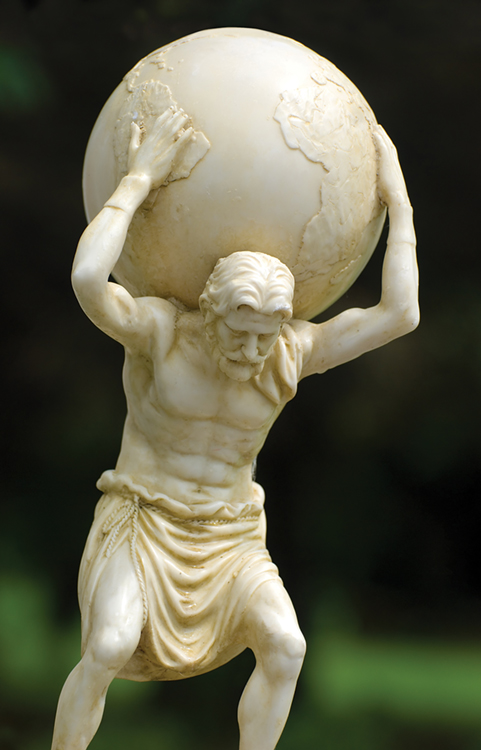
Jotnar, the Nordic giants, come from a realm altogether different. The Vikings feared the mammoth mountain ranges because they had been home to the Jotnar since the beginning of time. Big, tall mountains that pierced through the sky, having snowy tops, often made it easy for the giants to dwell there. Vikings also talk about giants in dark forests, the sea, and other places. The first Jotun, Ymir, was born when fire from Muspelheim, the realm of fire, met ice from Niflheim, the realm of ice, in the Gulf of Ginnungagap. It is said that he could give birth without a partner, using his hair and limbs as a means of reproduction. The ancient poems tell us that after the God of all Gods, Odin, and his brothers Vili and Ve, killed Ymir, they created the world from Ymir’s remains. His flesh formed the earth, and his blood gave rise to the ocean. His bones were used to form the tall hills, and his hair was used to make the trees. His skull made heaven. His brows made up for the powers of the formed Midgard (ancient earth) for the sons of men. His brain was turned into heavy clouds. Odin and his brothers lived between fire and mist, a place with no land for life to dwell upon, and killing Ymir could give them the resources to create the world.
Over time, other poets shared their views on the giants. The masses started to know this clan through their words. Alcman, Homer, Ovid, and others described them as violent, scary, gigantic creatures, comparing them to mountains. Hence, it was also believed that the Giants were responsible for causing earthquakes and volcanic eruptions.
Nordic Giants were another compelling character of the old world. Like the Gods, a Clan with supernatural powers was not always depicted as evil. The frost giants and the fire giants showed their strengths and purposes at different stages of the Ragnarok. While we are more familiar with Odin, Thor, and Loki, thanks to Marvel, the Jutul clan (Nordic Giants) was no less. We might become more familiar with the Jutuls thanks to Marvel, but the main question remains unanswered. Mythological events, such as the Nordic Ragnarok, Gigantomachy, and Titanomachy, make us wonder if they were just folklore. They also might have seemed impossible for humans to comprehend. Is there any truth to the existence of the Giants?
Let’s take a look at history. In 2013, a giant skull was found in Ecuador. The anatomy revealed that the being stood 7 feet 4 inches high and was deceased approximately 600 years ago. Five more specimens were found in the same area. That might not raise an eyebrow. We should consider Robert Wadlow. He was the tallest person ever recorded. He stood 8 feet 11 inches tall. But we have more. In 1871, 200 giant skeletons were unearthed at a Native American burial site. Some of these skeletons measured up to 9 feet tall. We are familiar with big footprints discovered all around the globe. One such impression was found in South Africa. It was 1.2 meters long, giving an estimated height of 24-27 feet, and is said to be around 200 million years old. Scientists confirmed that there are no chisel marks around it, but its origin remains a mystery. Similarly, we discovered giant 2-foot-long footprints in China, which are a staggering 13 feet high.
Is the existence of the Giants that surprising? It is a fact that the ancestors of many modern-day animals were gigantic. We are familiar with the Megalodon, an ancient extinct species that grew to 60 feet long. The prehistoric turtles grew as large as an average car. Even prehistoric spiders were 13 inches long with a leg span of 20 inches. Since oxygen levels were comparatively high, anything from mushrooms and trees to bugs and beetles grew to gigantic proportions. Then why wouldn’t an early ancestor of Homo Sapiens become a giant? Recently, it was discovered that three human species coexisted on this planet 200 million years ago. However, their interactions remain a mystery. But such a discovery sheds light on a possibility.
Whether giants existed or not? Have these mythological stories started to entertain and control the masses? Or were there, in fact, tribes exhibiting strength and stature like that of no ordinary men?
The question will linger a bit longer. Nonetheless, conspiracy theorists and mythology enthusiasts can surely enjoy these old relics.
 The Witty Stride
Leave a comment